The Future of Economic Development: How Human Futures Lab is Orchestrating Canada’s Next Economy
Building regenerative ecosystems through symbiotic orchestration, Indigenous partnership, and AI-native infrastructure
In an era of unprecedented technological capability and urgent need for sustainable economic models, a new approach to economic development is emerging—one that transcends traditional boundaries between sectors, cultures, and technologies. At Human Futures Lab (HFL), we’re pioneering what we call symbiotic orchestration: a methodology for coordinating complex stakeholder ecosystems to create mutually beneficial economic relationships that strengthen rather than exploit natural and social capital.
Beyond Traditional Economic Development
Most economic development approaches operate within colonial paradigms—extracting value from communities and environments to benefit distant stakeholders. Whether it’s technology companies harvesting user data, resource extraction depleting Indigenous lands, or AI systems displacing human workers, the pattern remains consistent: communities bear the costs while others capture the benefits.
Symbiotic orchestration represents a fundamental shift.
Instead of extracting value, we coordinate value creation across entire ecosystems, ensuring that every stakeholder—from individual communities to global corporations—benefits from collaborative success. This isn’t just ethical business; it’s the foundation for economic systems that can sustain prosperity across generations.
The Three Pillars of HFL’s Approach
1. Dynamic Range AI: Building Response-ability for Regional Resilience
Traditional AI deployment follows a hub-and-spoke model: sophisticated systems developed in urban centers and deployed to rural areas as consumers. Our Dynamic Range AI program flips this paradigm, focusing on building net new capability and leadership capacity in rural areas through AI-native but hybrid systems that maintain essential human engagement and oversight.
This approach recognizes that rural and Indigenous communities possess knowledge systems and governance approaches that can enhance rather than be replaced by artificial intelligence. By developing AI centers of excellence in rural areas, we create technological capability that serves community values while connecting to broader economic networks.
The result? Communities become technology leaders rather than technology consumers, developing solutions that address their specific challenges while contributing to national innovation capacity.
2. BRIDGE: Indigenous-Led Economic Sovereignty
Our Building Regional Investment & Development Governance Excellence (BRIDGE) program, led by our expertise in heutagogical learning and Indigenous partnership, addresses the critical need for community-controlled economic development that respects Indigenous sovereignty while building technological capability.
Rather than imposing external development models, BRIDGE supports communities in defining their own development pathways through:
Heutagogical Learning: Self-directed learning approaches that allow Indigenous learners to determine their own pathways while accessing broader networks
Cultural Integration: Technology deployment that strengthens rather than displaces traditional knowledge systems
Community Governance: Development frameworks that respect Indigenous self-determination while creating bridges to broader economic participation
The program is anchored on First Nations Open Access network projects, demonstrating how digital sovereignty and economic empowerment can advance together.
3. MAVI Trust Infrastructure: Validating Regenerative Value Creation
The challenge with regenerative economic development has always been validation—how do we verify that claimed community benefits and environmental improvements are real rather than performative? Our MAVI (Market Agility Value Integration) ecosystem solves this through blockchain-enabled trust infrastructure that provides cryptographic validation of impact claims.
MAVI operates as “The Trust Infrastructure for Regenerative Economies,” featuring:
Integrity Vault™ System: Cryptographic and social consensus validation ensuring every impact claim is auditable and non-speculative
Grant Augmentation Framework: Integration of philanthropic grants with corporate investments, generating revenue through certified funding integration
Symbiotic Value Creation: “Me+We engine” ensuring corporate success directly funds community prosperity through transparent mechanisms
Attestation Loop Governance: Agentic AI and human validation teams providing formal verification of outcomes
Our approach isn’t theoretical—it’s actively being implemented through strategic partnerships with established Indigenous-led institutions.
HFL’s integration enhances this foundation by providing:
Systematic Collaboration Methodology: The orchestration framework that enables complex multi-stakeholder coordination
Impact Validation: MAVI trust infrastructure ensuring transparent benefit distribution and verified community outcomes
Leadership Development: Dynamic Range AI and BRIDGE programs building community capacity for autonomous economic development
The Canadian Advantage: Positioning for Global Leadership
Canada’s unique position—combining Indigenous knowledge systems, technological capability, and commitment to reconciliation—creates unprecedented opportunity for global leadership in regenerative economic development. Prime Minister Carney’s “One Canadian Economy” mandate provides policy alignment, while the $200 million Regional AI Initiative and $5.2 billion Indigenous connectivity gap create market conditions for systematic transformation.
Our integrated protocol and framework directly supports federal priorities while demonstrating how Indigenous partnership and technological advancement create mutual benefits rather than zero-sum competition. By ensuring that AI deployment respects community sovereignty and economic development enhances cultural preservation, we’re building the foundation for economic models that other nations will study and adapt.
Ecosystem Orchestration in Practice
The Network Effect
Traditional economic development focuses on individual projects or organizations. Symbiotic orchestration operates at the ecosystem level, coordinating relationships between:
Federal and provincial governments seeking to achieve reconciliation and innovation objectives
Indigenous communities building economic sovereignty while maintaining cultural integrity
Private sector partners requiring verified ESG impact and community partnership
Academic institutions developing research partnerships that serve community priorities
Financial institutions seeking impact investment opportunities with transparent outcomes
By orchestrating these relationships systematically rather than project-by-project, we create network effects where each successful collaboration strengthens the entire ecosystem.
Value Stream Coordination
Beyond relationship orchestration, HFL coordinates value streams across the ecosystem to ensure equitable benefit distribution. This includes:
Knowledge Transfer: Ensuring Indigenous communities control and benefit from their knowledge contributions
Financial Flows: Transparent mechanisms ensuring corporate success funds community prosperity
Technology Development: Community-controlled innovation that strengthens traditional practices while building technological capability
Policy Integration: Systematic approach to regulatory frameworks that support rather than constrain community-controlled development
Looking Forward: The 5-Year Vision
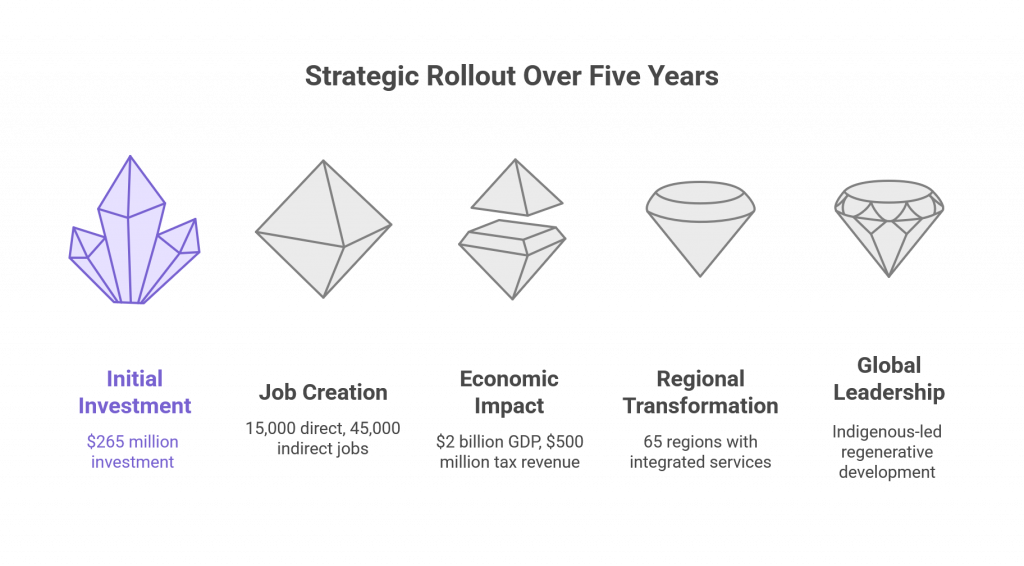
Our strategic framework envisions systematic rollout across 65 regions over five years, requiring $265 million investment to create:
15,000 direct jobs and 45,000 indirect positions
$2 billion GDP contribution and $500 million tax revenue generation
65 regions transformed through integrated symbiotic orchestration services
Global leadership in Indigenous-led regenerative economic development
More importantly, this investment creates the foundation for economic systems that generate prosperity through cooperation rather than competition—systems that strengthen communities, environments, and cultures while building technological and economic capability.
The Path Forward: From Colonial to Collaborative Economics
The transition from extractive to regenerative economics isn’t just about better business practices—it’s about fundamentally reimagining how economic systems can serve human flourishing. At Human Futures Lab, we’re not just building services; we’re demonstrating that economic development can be a force for community empowerment, cultural preservation, and environmental restoration.
Our work with Indigenous communities through the BRIDGE program, rural AI development through Dynamic Range AI, and transparent impact validation through MAVI trust infrastructure proves that technology can serve community values rather than displace them.
As we prepare for strategic partnerships with our Indigenous Groups and Leadership and expanded collaboration with government agencies, we’re building the foundation for Canada’s leadership in the next economy—an economy where prosperity flows through strengthening communities rather than extracting from them.
Join the Transformation
The future of economic development isn’t about choosing between technology and tradition, economic growth and environmental protection, or individual success and community benefit. It’s about orchestrating systems where these apparent tensions become sources of mutual reinforcement.
At Human Futures Lab, we’re proving that symbiotic orchestration can create economic systems that serve all stakeholders while building the foundation for sustainable prosperity across generations. Whether you’re a government agency seeking to achieve reconciliation objectives, a private sector partner requiring verified community impact, or an Indigenous community exploring pathways to economic sovereignty, we invite you to explore how orchestrated collaboration can advance your goals while contributing to systematic economic transformation.
The next economy isn’t coming—it’s being built through the coordinated actions of partners who understand that our individual success depends on our collective flourishing. Human Futures Lab provides the orchestration framework to make that vision reality.
—
*Learn more about Human Futures Lab’s symbiotic orchestration strategies and explore partnership opportunities. Follow our work as we build Canada’s foundation for regenerative economic development through Indigenous partnership, AI-native infrastructure, and transparent impact validation.*